
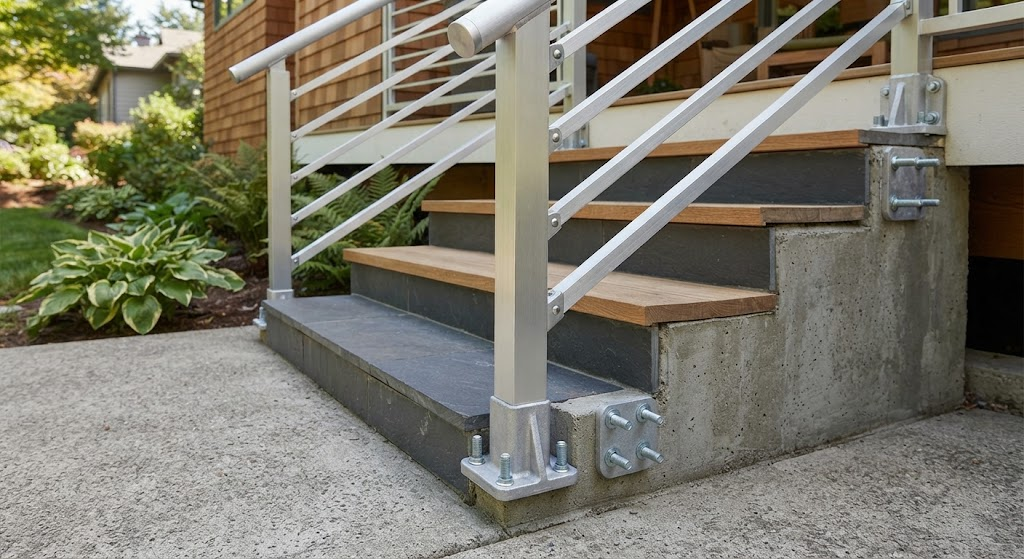
Secure mounting points determine whether aluminum stair railings remain dependable under everyday use, sudden pressure, and changing environmental conditions. Brackets and fasteners may be small components, but they connect the handrail to the structure and help preserve structural integrity, fall prevention, and code compliance. Understanding how to choose, position, and inspect these connections makes railing safety a planned outcome rather than an assumption.
Mounting Points and Aluminum Stair Railing Safety
In aluminum stair railings, mounting points transfer force from the handrail into posts, walls, or other supporting structures. When these connections are inadequate, the railing may loosen or deflect even if the aluminum components themselves remain intact.
The required load-bearing capacity depends on the building, railing design, and applicable regulations. Building codes and project specifications should guide the selection and verification of components; a product’s appearance alone cannot establish its suitability.
Bracket Types and Their Functions
Wall brackets connect a handrail to a suitable wall or structural backing, while post-mounted fittings attach rails to railing posts. Adjustable brackets can accommodate stair angles, but they still need to be compatible with the handrail profile and designed for the forces involved.
Fasteners must match the supporting material. Anchor bolts may be appropriate for certain concrete or masonry installations, while wood, steel, and hollow sections call for different fastening methods or reinforcement. The connection is only as dependable as its weakest part.
Selection and Code Compliance for Railing Connections
Choosing hardware begins with the installation conditions: substrate, handrail shape, stair geometry, expected use, and exposure to moisture or corrosive environments. In busy public or industrial settings, specified performance ratings and manufacturer documentation can help demonstrate that components meet the project’s requirements.
Code compliance must be confirmed against local rules and the relevant project documents, rather than assumed from a generic guideline.
| Installation condition | Selection consideration | Verification focus |
|---|---|---|
| Concrete or masonry | Compatible anchors and required embedment | Substrate condition and secure engagement |
| Wood framing | Fasteners reaching sound structural material | Correct location and firm attachment |
| Hollow or thin-wall sections | Reinforcement or backing where specified | Resistance to movement and pullout |
| Exterior exposure | Appropriate finish and corrosion resistance | Signs of corrosion, loosening, or damage |
Installation Practices That Protect Structural Integrity
Accurate layout helps distribute loads across attachment points and keeps the rail aligned through stair runs and landings. Installers should follow the product instructions, select fasteners for the actual substrate, and use specified tightening procedures; improvised substitutions can weaken the assembly.
Before installation, confirm that the supporting surface is sound and that bracket positions avoid conflicts with stair components. Thin-wall or hollow sections may need reinforcement, while exterior systems require suitable materials and finishes to support corrosion resistance.
A practical installation review should cover several details, not just whether the rail looks straight:
- Confirm bracket spacing, alignment, and compatibility with the handrail.
- Check fastener type, embedment, and tightening against the project instructions.
- Inspect transitions, landings, and connections to posts or structural backing.
- Verify the completed assembly and document checks required by the project.
These measures support installation safety and help identify looseness or damage before it affects users. Separate safety systems have their own requirements; for example, door and window sensor guidance concerns a different installation but reinforces the value of matching components to their intended purpose.
Coordination and Long-Term Railing Reliability
Railing brackets work within a larger assembly that may include posts, stair pans, treads, landing pans, and infill panels. Coordinating their locations with stair geometry and structural supports helps avoid misalignment and ensures connections do not interfere with adjacent components.
After installation, periodic inspection can reveal loose fasteners, corrosion, or movement at mounting points. Where design conditions, substrate strength, or code interpretation are uncertain, a qualified installer, engineer, or building professional can assess the system and recommend appropriate measures.