Curved furniture is reshaping contemporary interiors, replacing rigid lines with forms that feel softer, more sculptural, and more connected to the way people move through a room. From rounded sofas to gently arched chairs, these pieces can make modern living spaces feel welcoming without sacrificing clarity or function.
Curved Furniture and the Language of Contemporary Interiors
In contemporary interiors, curved furniture introduces contrast: a rounded silhouette stands out against rectangular windows, shelving, and floor plans. That contrast adds movement and can make a room feel less formal, especially when several pieces share a restrained palette or related materials.
The approach has deeper roots than current interior design trends. The flowing lines of Art Nouveau and the sculptural furniture of the mid-century period both explored forms inspired by nature, though today’s designs often pair those gestures with practical upholstery and compact proportions.
Rather than filling a room with curves, designers often use one or two prominent pieces to establish a focal point. The result feels deliberate, with soft silhouettes bringing character while the rest of the room provides visual balance.
Organic Shapes That Balance Form and Function
Organic shapes work best when appearance and everyday use support each other. Before choosing a piece, consider how people enter, sit, converse, and move through the space; a beautiful outline should not obstruct a doorway or narrow a main walkway.
Rounded Sofas for Conversation and Comfort
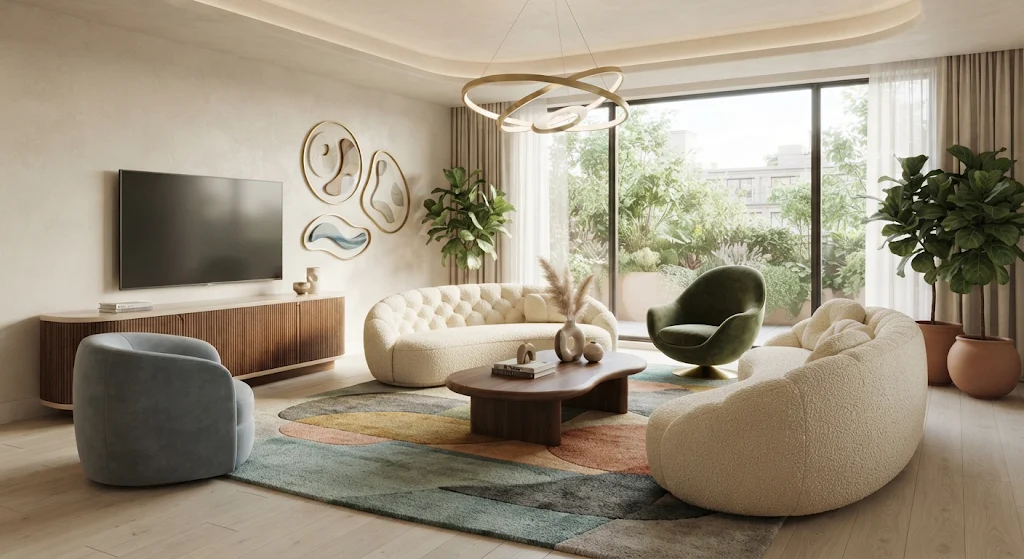
Rounded sofas can encourage face-to-face conversation by drawing seats toward one another. Their continuous contours also soften large open-plan rooms, where a straight sofa might reinforce the box-like shape of the space.
Scale matters: a curved sofa with a deep profile can dominate a small room, while a compact design may define a seating area without closing it off. Pairing it with a simple side table keeps the arrangement useful and avoids crowding its outline.
Fluid Forms in Chairs and Tables
Chairs, coffee tables, and side tables offer a lower-commitment way to introduce fluid forms. A rounded table can ease circulation around a seating group, while a chair with an arched back adds a sculptural note without competing with larger furniture.
Material choice shapes the effect. Upholstery and wood tend to feel warm and tactile; metal or polished stone can make the same curves appear more formal. A useful guiding principle is to let one finish lead and keep supporting surfaces quieter.
Spatial Harmony Through Layout and Proportion
Curves need room to read clearly. A rounded piece placed too close to angular furniture may look accidental, whereas a little breathing space lets its outline become part of the room’s rhythm.
For a cohesive arrangement, consider these practical principles:
- Leave clear routes between entrances, seating, and frequently used areas.
- Balance one prominent curved piece with simpler, linear furnishings.
- Repeat a rounded detail in a mirror, lamp, or textile for visual continuity.
These choices help maintain spatial harmony while keeping the room comfortable to use. They also show why curved furniture is not limited to large homes: a modestly scaled chair or oval table can soften a compact layout without consuming unnecessary floor area.
Contemporary Materials and Lasting Design
Upholstery, frame construction, and maintenance all influence whether sculptural design remains practical over time. Durable fabrics suit frequently used seating, while exposed wood or metal frames can lend definition to softer, upholstered shapes.
When comparing options, look beyond the first impression. The following qualities can help a piece remain both functional and visually relevant:
| Design choice | Effect in a living space |
|---|---|
| Textured upholstery | Adds warmth and makes rounded profiles feel inviting. |
| Visible wood or metal legs | Creates visual lightness beneath substantial forms. |
| Muted, adaptable colors | Allows distinctive silhouettes to work with changing décor. |
Interior design trends may shift, but well-proportioned forms and useful materials tend to outlast seasonal styling. Choosing pieces that suit the room’s scale and daily routines turns a striking shape into a lasting part of the home.
Curved Furniture as a Thoughtful Design Choice
Curved furniture can bring comfort, visual movement, and personality to contemporary living spaces when its form is matched to the room’s proportions. A restrained mix of rounded pieces, practical materials, and clear circulation creates a home that feels expressive rather than crowded.
For a layout or furnishing plan tailored to a particular space, consult an interior design professional who can assess its dimensions, lighting, and everyday needs.