Custom rug patterns can bring an established room into focus, but the wrong design may compete with its upholstery, curtains, and artwork. Successful furniture coordination depends less on matching every color than on balancing pattern scale, connecting a few tones, and choosing a design that suits the room’s character. With a clear approach to rug selection, pattern mixing can add personality while preserving design harmony.
Pattern Inventory for Custom Rug Patterns and Existing Furniture
Before comparing rugs, take stock of every visible pattern in the room. Include upholstery, curtains, cushions, throws, and prominent artwork; overlooked details can make an otherwise appealing combination feel crowded.
Classify each element as solid, geometric, striped, floral or organic, or abstract. Most spaces feel balanced with two or three distinct pattern types, provided one leads and the others play supporting roles. A room with a large floral sofa and striped chairs, for instance, will usually benefit from a restrained rug rather than another bold motif.
Consider furniture styles as well as patterns. Traditional carved frames often suit medallions or botanical designs, while clean-lined contemporary pieces can support broad geometric shapes or subtle abstracts. These are useful starting points, not rigid rules: a shared color can help an unexpected pairing feel intentional.
Scale Rules for Furniture Coordination and Pattern Mixing
Once the room’s patterns are mapped, compare their visual scale. Two motifs with similar-sized repeats tend to compete, creating a restless effect; a clear difference in scale gives the eye a more comfortable rhythm.
Scale Contrast Between Upholstery and Rug
As a practical guide, choose a rug pattern roughly twice as large as the dominant upholstery motif, or much smaller and more discreet. A sofa with a small geometric repeat may pair well with a broad trellis, while a large floral sofa is often better grounded by a tight texture or near-solid rug.
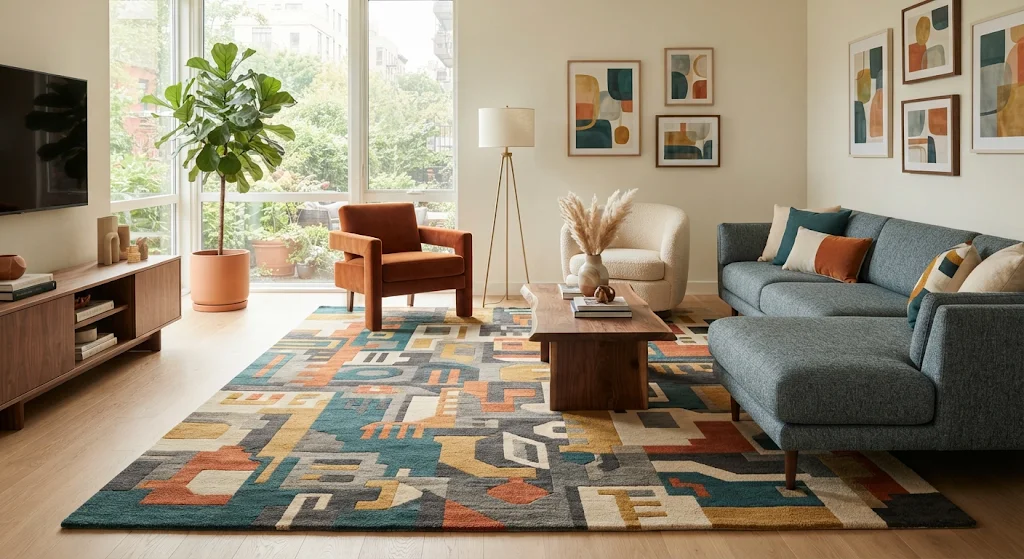
When the furniture is mostly solid, there is more freedom to use a pronounced pattern. Still, the rug’s size matters: a design that looks striking in a close-up image may appear faint across a large floor. Check full-room photographs and measure the seating area before deciding.
Use this quick comparison to guide the first round of options:
| Existing Furniture | Rug Pattern Direction | Design Aim |
|---|---|---|
| Solid upholstery | Bold geometric, floral, or abstract | Give the floor a focal role |
| Small-scale pattern | Larger-scale motif or quiet texture | Establish clear scale contrast |
| Large floral or stripe | Solid, tonal, or fine all-over pattern | Let the upholstery lead |
| Mixed furniture styles | Faded vintage or soft geometric | Bridge different design languages |
Color Matching That Connects Furniture and Room Decor
A rug need not repeat the sofa’s exact color. Instead, look for one shade already present in the room—perhaps in a cushion, artwork, wood finish, or lamp—and let it appear in the rug as a main or supporting color.
Color Relationships and Undertones
Check undertones before choosing among neutrals. A gray sofa may lean blue or brown, while beige can appear pink, yellow, or green beside other surfaces. Samples viewed in the room’s natural and evening light reveal these differences more reliably than a screen.
Contrast also helps separate furnishings. A light rug beneath dark seating, or a warm accent within a cooler palette, can create depth without making the scheme feel disconnected. Texture contributes too: wool’s subtle tonal variation can soften transitions, while a detailed pattern generally reads more clearly in a flat-weave or low-pile construction.
Room Layout Choices for a Cohesive Rug Selection
Pattern decisions should account for how the room is used. In a living area, a rug large enough to visually gather the seating creates a more settled arrangement; an undersized rug can make coordinated furnishings seem scattered.
Open-plan spaces need particular care. Adjacent rugs can share a color while using different pattern families, such as a geometric design near an organic floral. This distinction marks zones without making the transition abrupt.
Before finalizing a design, check these practical details:
- Measure the furniture grouping and the available floor area.
- View a full-size image or sample in the intended location and lighting.
- Keep detailed motifs on low-pile or flat-weave rugs, where their lines remain visible.
- For a dining area, favor a simpler pattern that does not compete with table settings.
Thoughtful choices connect home furnishings without making the room look overly coordinated. When the layout, materials, and competing patterns are difficult to balance, an interior design professional can offer guidance tailored to the space.