
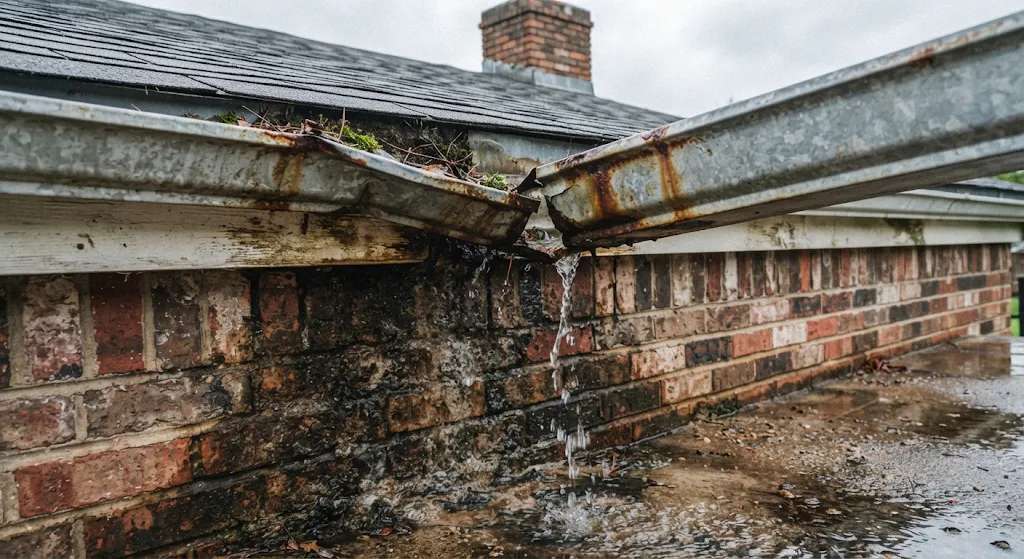
Gutters are designed to move rainwater away from a home, but repeated patching cannot restore a system that has lost its shape, strength, or reliable drainage. When leaks return, sections sag, or water begins damaging the roofline and foundation, the issue may extend beyond a single faulty joint. Knowing when repair has reached its limit helps prevent a small maintenance problem from developing into extensive property damage.
Recognize When Gutter Repairs Stop Working
A repair is usually effective when the defect is isolated and the surrounding gutter remains firmly attached, correctly sloped, and free of significant corrosion. A small split, loose hanger, or leaking seam can often be addressed without replacing the entire system.
The warning signs change when the same problems recur or appear in several areas. Recurring leaks, sagging gutters, overflowing sections, and visible rust or cracks can indicate that the material or supports have deteriorated too broadly for spot repairs to last.
Identify Widespread Gutter Damage
Check whether water escapes from multiple seams, whether sections pull away from the fascia, and whether the gutter keeps its shape after cleaning. If a repair solves one leak only for another to emerge nearby, extensive gutter damage may be affecting the system as a whole.
Trace Water Damage Beyond the Gutter
Stains or soft, decaying wood along the fascia, peeling siding, and pooling near the home are signs that water has been escaping for some time. This can lead to structural water damage, roofline deterioration, and foundation issues, making it important to assess the affected areas as well as the gutter itself.
Because gutters connect directly to the roof edge, related defects may also deserve attention. Guidance on signs a roof may need professional attention can help distinguish a gutter fault from a broader roofline concern.
Assess Whether Replacement Is the Better Solution
Once damage is visible in more than one location, the decision should account for the system’s overall condition, not just the most obvious leak. A professional gutter inspection can assess the gutters, fasteners, slope, downspouts, fascia, and discharge points together.
These signs help clarify whether another repair is likely to hold or whether gutter replacement offers a more dependable solution:
- Several sections leak, crack, or show corrosion, rather than one isolated joint.
- Gutters remain loose or sag despite adjustments to their supports.
- Water continues to overflow because the system cannot carry runoff effectively.
- Fascia, siding, or nearby ground shows signs of prolonged moisture exposure.
A replacement may also be appropriate when repairs have become a repeating cycle without restoring reliable performance. The aim is not to replace a sound system unnecessarily, but to avoid investing in patches that leave the underlying failure untouched.
| Condition | Likely next step | Reason |
|---|---|---|
| One loose hanger or isolated seam leak | Repair | The rest of the system remains sound and correctly aligned. |
| Leaks in several areas or persistent sagging | Inspect for replacement | Damage may affect multiple sections or the supporting structure. |
| Water damage to fascia or pooling near the foundation | Assess the full drainage path | Secondary damage may require attention beyond the gutter itself. |
Gutters are only one part of the roof’s water-management system. Failed flashing can also direct moisture behind exterior materials; learn more about roof flashing failure and repair when leaks appear near roof edges or wall junctions.
Restore Reliable Drainage Across the Home
Even intact gutters can perform poorly if they are clogged, incorrectly pitched, or connected to blocked downspouts. This kind of poor drainage can resemble system failure, so debris and discharge routes should be checked before deciding that replacement is necessary.
When cleaning and targeted adjustments do not resolve overflow, or when the same defects return after repair, the system may be approaching gutter system failure. A specialist can determine whether the cause is a local obstruction, damaged components, or a combination of gutter and roof problems.
Address the Cause, Not Just the Leak
Replacing damaged sections without correcting poor slope or blocked outlets can leave the original problem in place. A thorough assessment should follow rainwater from the roof edge through the downspouts to a safe discharge point, while checking for deterioration around the eaves.
Where urgent roof leaks accompany gutter problems, advice on preventing and managing emergency roof repairs offers relevant context. The lasting fix depends on identifying the full path of water, not simply sealing its most visible exit.
When recurring leaks, sagging, or signs of structural water damage persist, arrange a professional gutter inspection before further deterioration develops. A qualified contractor can provide a tailored assessment and recommend repair or replacement based on the system’s condition.